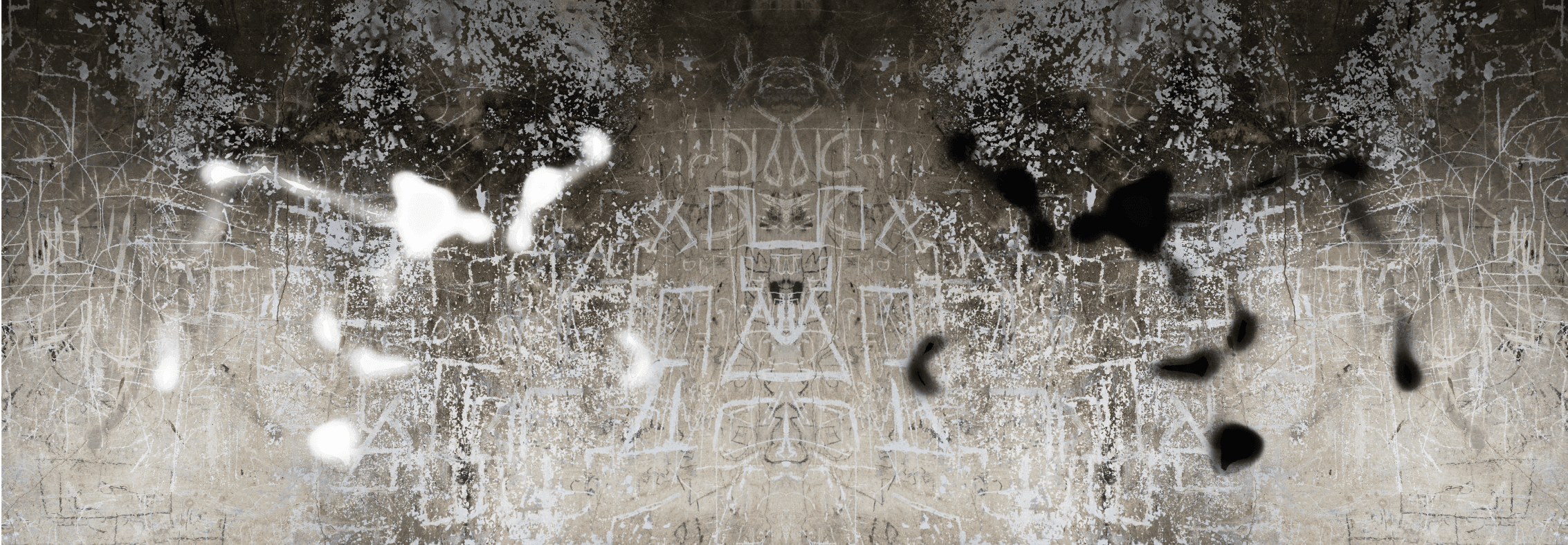
ual digital processing combining eye tracking and symmetrical montage, 140 × 70 cm
In this work I construct a space in which two registers of vision confront one another—or more precisely, coexist side by side on the same visual plane. On the right, the mapping of the gaze appears as heavy, dark, almost violent stains. On the left, the very same mapping radiates with brightness and a sense of hope. Behind them lies a charged, inscribed wall bearing traces of bodies, writings, and the lived presence of passersby and transient dwellers who once inhabited the abandoned structure.
The turn toward a symmetrical composition introduces an almost clinical or scientific resonance, reminiscent of medical imaging. Yet here the “patient” is not the wall but the act of seeing itself. What undergoes diagnosis is vision: the eye’s movement translated into a fractured mirror of consciousness. The gaze is no longer a neutral tool for apprehending reality, but a technological, political, and deeply personal force that shapes perception while simultaneously concealing information through the very act of looking.
I do not seek to resolve the polarity between these two possibilities. Rather, I position the viewer within the split itself and implicate my own gaze as an object of observation