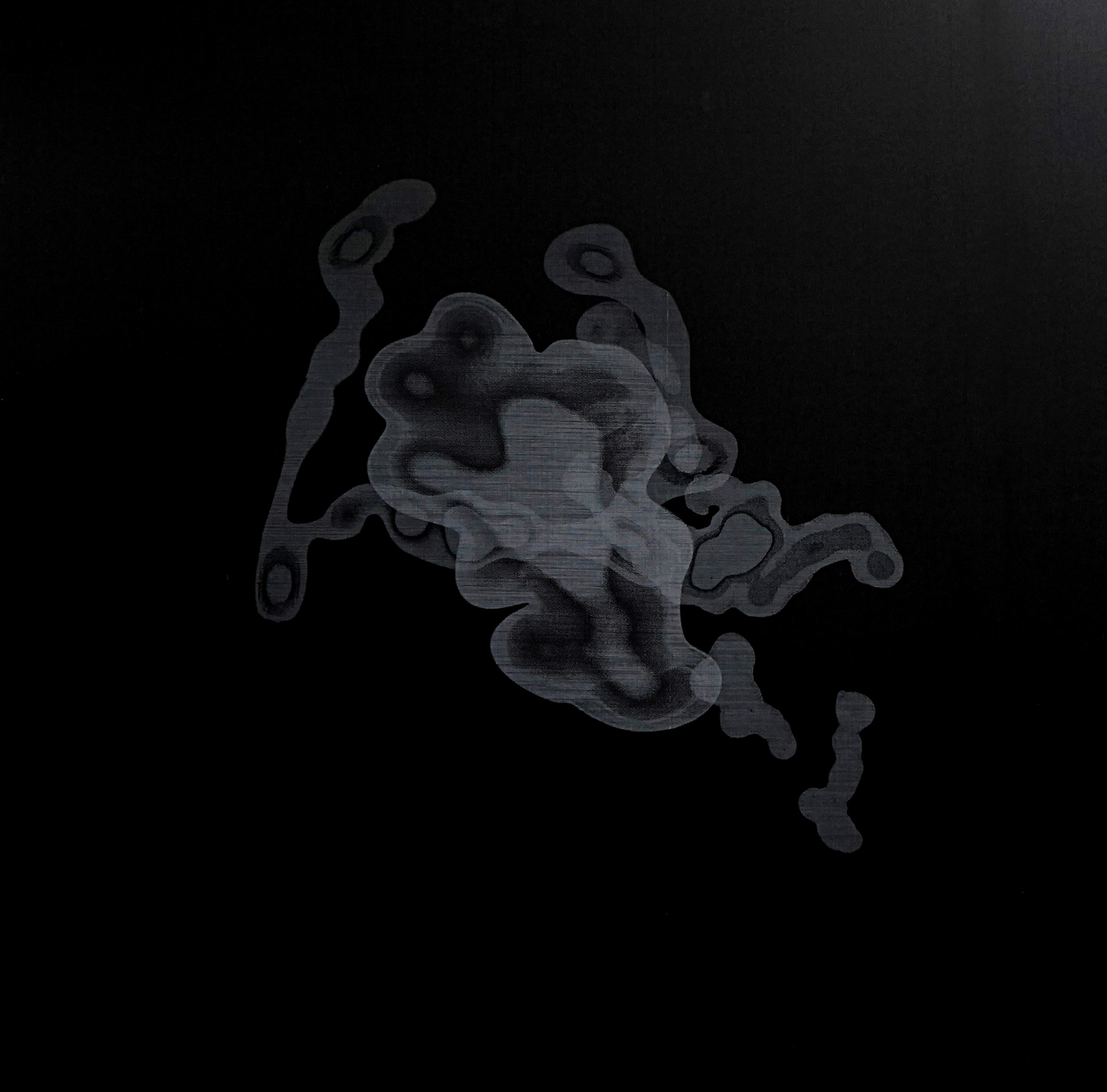
In the work “Crossing Gazes” I use a dedicated eye-tracking system designed to map user behavior in virtual environments in order to trace the movement of my gaze across family photographs. The system measures gaze trajectories and dwell time across different areas of the image, producing a visual output in the form of colored stains that indicate varying degrees of attention and interest. After conducting three separate mappings on three different images, I remove the mapping from the original photograph, isolate it, and grant it an independent existence as a stain, as a new unit of vision.
These residues of sight converge into a new composition, a kind of family photograph of a different order. A choreography of the gaze, layers of vision that cannot coexist simultaneously within a single human eye. It is a split gaze, or a remainder of gaze, that has left my body through the system and returned to me as a visual entity.
The algorithms operate through me and through the machine, and between us unfolds a game of reciprocal observation in which it is no longer clear who is observing whom. The image itself disappears. In its place remains a transparent movement that has turned into matter, a memory condensed into an act of vision without an object. Time loses its relevance, and the eye is revealed as an autonomous entity without an owner, operating according to its own laws. Dwell time becomes a stain. Movement condenses into form. No movement is identical to another. Each action releases into the world a new creature of vision.